

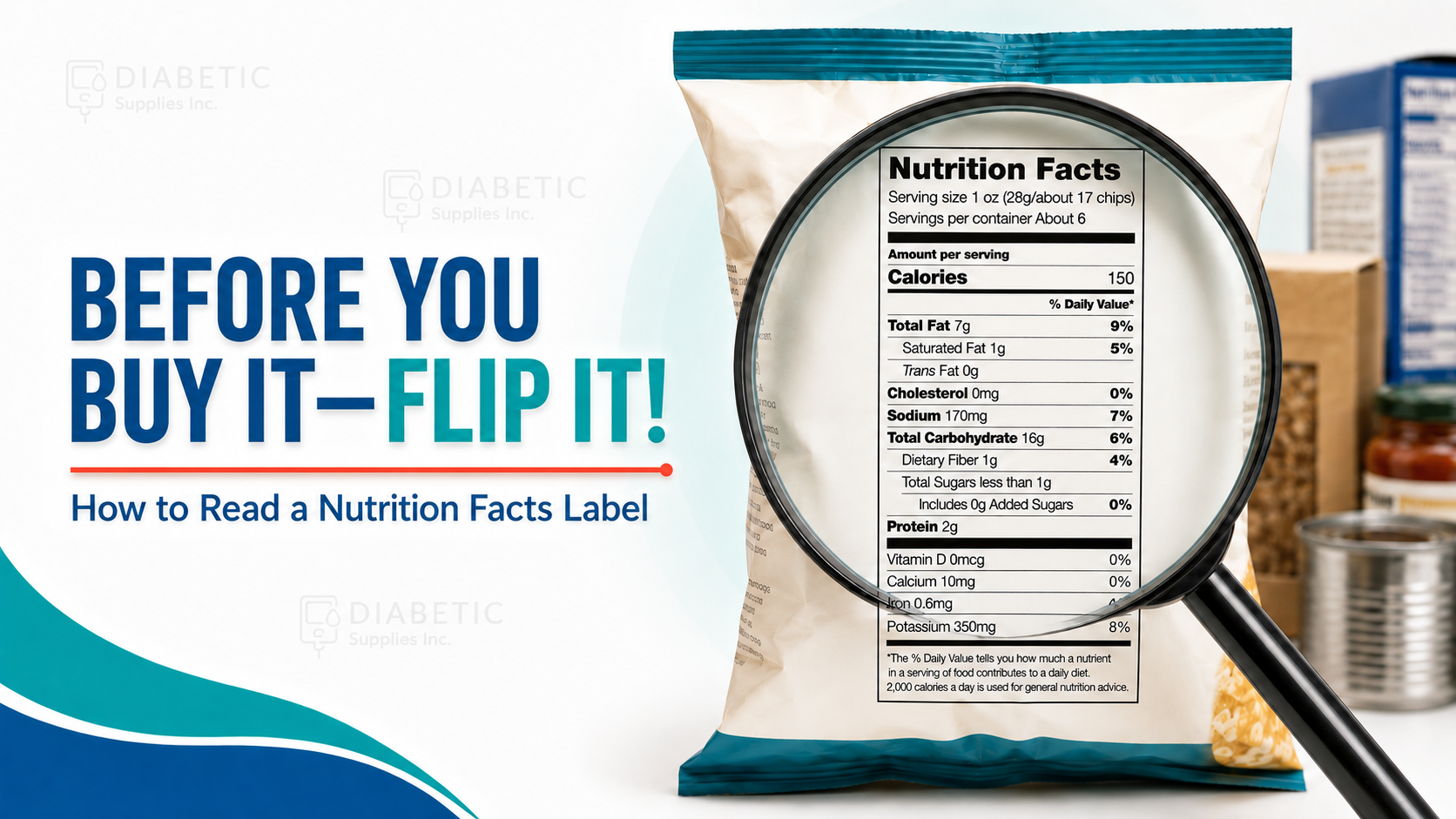
Food packages are designed to catch your attention. Words like “healthy“, “natural“, “low-fat” and “sugar-free” may sound reassuring—but the front of the package does not always tell the whole story.
The Nutrition Facts label gives you the information you need to compare foods and make choices that support your health. For people living with diabetes, understanding serving sizes, carbohydrates, fiber, added sugars, and sodium can be especially helpful.
Here are the most important areas to check before placing an item in your shopping cart.
1. Begin With the Serving Size
The serving size appears near the top of the Nutrition Facts label. Every number below it—including calories, carbohydrates, sugar, fat, and sodium—is based on that amount.
For example, imagine that a package contains two servings, but you eat the entire package. You would consume twice the calories, carbohydrates, sodium, and other nutrients listed for one serving.
Before reviewing anything else, ask yourself:
- How large is one serving?
- How many servings are in the package?
- How much am I actually planning to eat?
A serving size is a reference amount used on the label. It is not necessarily a recommendation for how much you personally should eat.
2. Check Total Carbohydrates
Carbohydrates have a direct effect on blood glucose, making this one of the most important sections for many people with diabetes.
The Total Carbohydrate number includes sugar, starch, and dietary fiber. When counting carbohydrates, look at the total number of grams per serving—not only the sugar listed beneath it.
You may also see phrases like “net carbs” printed on the front of certain packages. According to the American Diabetes Association, “net carbs” is not a term defined by the FDA.
Start with the Total Carbohydrate amount and speak with your healthcare provider or registered dietitian if you need help establishing a personal carbohydrate goal.
3. Look for Dietary Fiber
Fiber is a type of carbohydrate that the body does not completely digest. Fiber-rich foods can support digestive health, help you feel satisfied after eating, and may support blood glucose and cholesterol management.
The American Diabetes Association explains that,
- 5 grams or more of fiber per serving is considered high in fiber.
- 2.5 grams or more per serving is considered a good source of fiber.
Foods that may provide fiber include vegetables, fruit, beans, lentils, nuts, seeds, and whole grains.
Remember that a food containing fiber can still contain a significant amount of total carbohydrates. Review the complete label instead of relying on one number.
4. Understand Total Sugars and Added Sugars
Total Sugars includes sugars naturally present in foods, such as the sugar in fruit or milk, along with any sugars added during processing.
Added Sugars are sugars added to a product during preparation or processing. They can be found in obvious sweets like soda, candy, and baked goods, but they may also appear in sauces, flavored yogurt, cereal, drinks, and other packaged foods.
The word “includes” beside Added Sugars means those grams are already part of the Total Sugars amount. They should not be added together again.
Also, remember that “sugar-free” does not automatically mean carbohydrate-free. Always check the Total Carbohydrate amount.
5. Review Sodium
Sodium does not directly raise blood glucose, but consuming too much may increase the risk of high blood pressure and heart disease. This is particularly important because diabetes can already increase the risk of heart-related complications.
Sodium can be hidden in canned foods, frozen meals, soups, sauces, deli meats, snacks, and other packaged products.
The American Diabetes Association notes that the general recommendation is to stay below 2,300 milligrams of sodium per day, although your healthcare provider may recommend a different limit based on your individual health needs.
6. Pay Attention to the Type of Fat
The label separates fat into categories, including saturated fat and trans fat.
Instead of looking only at Total Fat, pay attention to the type of fat the product contains. In general, look for foods with more unsaturated fats and less saturated and trans fat.
Nuts, seeds, avocados, and certain oils can provide unsaturated fats, while saturated fat is commonly found in foods such as butter, fatty meats, and some highly processed products.
7. Use the Percent Daily Value
The Percent Daily Value (%DV) shows how much one serving contributes to the recommended daily amount of a nutrient, based on a 2,000-calorie diet.
A simple FDA guideline is:
- 5% Daily Value or less is considered low.
- 20% Daily Value or more is considered high.
You may want foods to be lower in saturated fat, sodium, and added sugars while being higher in nutrients such as dietary fiber, vitamin D, calcium, iron, and potassium.
Individual calorie and nutrient needs vary, so use the %DV as a comparison tool—not a personalized meal plan.
Turn the Package Around
A product’s front label is designed to attract attention. The Nutrition Facts label is where you can learn what the food actually provides.
Before purchasing a packaged food, remember to:
- Check the serving size.
- Review Total Carbohydrates.
- Look for dietary fiber.
- Compare Added Sugars.
- Check sodium and saturated fat.
- Use the % Daily Value to compare similar products.
You do not have to find a “perfect” food. The goal is to understand what you are eating and make informed choices that fit your personal diabetes care plan.
Diabetic Supplies Inc. is committed to supporting people living with diabetes through dependable service, helpful education, and access to essential diabetes supplies.