

Diabetes technology has come a long way from checking blood sugar with a meter and writing the numbers down in a logbook.
Today, continuous glucose monitors can show glucose trends throughout the day and night. Some insulin pumps can use CGM information to automatically adjust insulin delivery. Sensors are lasting longer, technology is becoming available to more people, and researchers and manufacturers are even looking beyond glucose alone.
And in 2026, that progress is continuing quickly.
You may have seen announcements about new devices and wondered:
What is actually changing — and what does it mean for people living with diabetes?
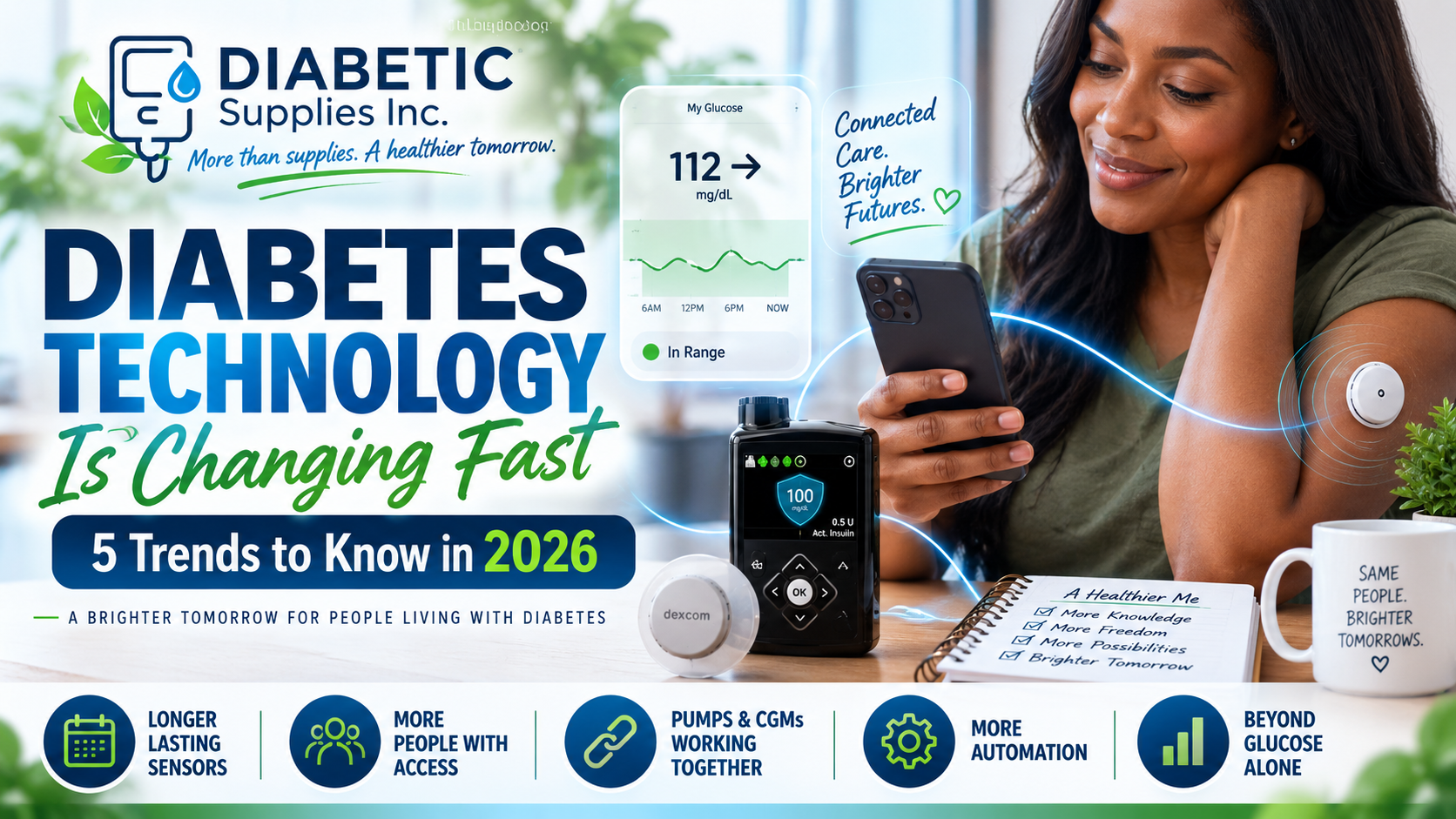
Here are five important trends shaping diabetes technology in 2026.
1. ⏰ CGM Sensors Are Lasting Longer
One of the most noticeable changes in continuous glucose monitoring is longer sensor wear.
For years, CGM users became accustomed to replacing sensors every 7, 10 or 14 days depending on the system. Newer technology is pushing wear times even further.
The FDA has cleared the Dexcom G7 15 Day Continuous Glucose Monitoring System, reflecting the industry’s continued movement toward longer-lasting sensors.
Why does longer wear matter?
For some users, it could eventually mean:
- Fewer sensor changes
- Less interruption to their routine
- Fewer applications and removals
- More continuous time using their CGM
Longer wear does not mean that every CGM now lasts 15 days. Different systems still have different wear times, age indications, features and compatibility requirements. The bigger story is that CGM technology continues to move toward making monitoring easier to fit into everyday life.
2. 📲 CGMs Are Reaching People Outside the Traditional Insulin-Using Population
CGMs were once used primarily by people who required intensive insulin therapy.
That is changing.
In June 2026, the FDA cleared Dexcom’s Stelo Glucose Biosensor System as an over-the-counter CGM for people 2 years of age and older who do not use insulin. Stelo had previously been cleared for adults ages 18 and older.
That is significant because it shows how continuous glucose information is expanding beyond the group traditionally associated with CGMs.
The American Diabetes Association’s 2026 Standards of Care also discuss evidence supporting CGM use in people with type 2 diabetes who are not using insulin.
In other words, we are beginning to see a broader shift from:
“Who needs a CGM?”
to:
“Who might benefit from seeing more information about their glucose?”
Of course, having access to more data does not replace medical guidance. People should still work with their healthcare providers to determine what type of glucose monitoring is appropriate for them.
3. 🤝 CGMs and Insulin Pumps Are Working Together More
Another major change is that diabetes devices are becoming less isolated from one another.
Instead of a CGM simply displaying a glucose reading while an insulin pump operates separately, automated insulin delivery systems, often called AID systems, allow the technologies to work together.
An AID system generally combines:
- A continuous glucose monitor
- An insulin pump
- An algorithm that uses CGM information to help adjust insulin delivery
The American Diabetes Association’s 2026 Standards of Care describe AID systems as the preferred insulin-delivery method for many people with type 1 diabetes and also recommend them for adults and children or adolescents with type 2 diabetes who use multiple daily insulin injections, depending on individual needs and circumstances.
That is a big shift.
For years, much of diabetes technology focused on giving people more information.
Now technology is increasingly being designed to help systems respond to that information too.
4. 🤖 Diabetes Management Is Becoming More Automated
Automation may be one of the biggest themes in modern diabetes technology.
An automated insulin delivery system can use CGM information—including where glucose is headed—to increase, decrease or pause insulin delivery based on the particular system and its settings.
That does not mean diabetes has become completely hands-off.
People still need education, supplies, device maintenance, troubleshooting and guidance from their healthcare team. Different systems also require different amounts of user interaction.
But there is an important trend happening:
Technology is beginning to take over some of the repetitive calculations and adjustments that once depended entirely on the person using the device.
Diabetes technology now also includes connected insulin pens, diabetes-management software and other digital tools designed to help people understand and manage their information.
The goal isn’t to remove the person from diabetes management.
It’s to give them better tools to help manage it.
5. 🩸 Monitoring Is Starting to Look Beyond Glucose Alone
This may be one of the most interesting developments of 2026.
Most wearable diabetes sensors have focused on one thing:
glucose.
But that is beginning to change.
On August 25, 2026, the FDA authorized the Libre Duo 10 Day Continuous Dual Glucose Ketone Monitoring System for people ages 2 and older living with diabetes.
It became the first wearable device authorized in the United States to continuously monitor ketones and the first device designed to continuously monitor both glucose and ketones together.
We’ve previously discussed this technology in more detail, so we won’t repeat everything here.
What’s important for this conversation is what it represents.
For decades, wearable diabetes monitoring has largely centered around glucose. Now we are beginning to see technology capable of continuously monitoring more than one piece of information from the body.
That raises an interesting question about the future:
What else might diabetes devices eventually be able to monitor?
We don’t know exactly where the technology will go next, but 2026 is showing that the traditional idea of a “glucose sensor” may continue to evolve.
🔮 So, Where Is Diabetes Technology Heading?
When you put all five trends together, there is a clear pattern.
Diabetes technology is moving toward devices that are:
- Longer lasting.
- Available to more people.
- Better connected.
- More automated.
- Capable of providing more information.
That doesn’t mean every new device is right for every person.
Technology choices should still be based on factors such as someone’s type of diabetes, treatment plan, age, insurance coverage, lifestyle, comfort with technology and recommendations from their healthcare team.
But one thing is becoming very clear:
Diabetes technology is no longer just about getting a glucose number.
It is increasingly about understanding trends, connecting devices, reducing some of the daily workload and giving people more information to help manage their health.
And if the progress we’ve already seen in 2026 is any indication, diabetes technology isn’t slowing down anytime soon.
Diabetic Supplies Inc.
Technology may change, but having dependable access to your diabetes supplies remains important.
Diabetic Supplies Inc. helps patients access diabetes supplies including continuous glucose monitors, insulin pump supplies, testing supplies and other diabetes essentials.
We work with Medicare, Medicaid and most major insurance plans, and supplies can be conveniently delivered to your home.
If you have questions about available diabetes supplies or getting started with Diabetic Supplies Inc., our team is here to help.
This article is for educational purposes only and is not intended to replace medical advice. Device availability, indications, compatibility and insurance coverage can vary. Always talk with your healthcare provider before making changes to your diabetes treatment or medical devices.